I never thought to write this story.
As soon as I had a second to process my miscarriage, I wrote down every detail. I didn’t want to forget the baby the world never got to meet. I wanted them to know he was here, even if it was just for a few weeks.
When I got pregnant with my living daughter, everything looked different. The way I shared with others, the way I monitored my body, the way I checked food labels, the way I held my breath every time I went to the restroom. When you are pregnant after you lose a child, you also lose your innocence.
I often encourage women and families to share their stories about their pregnancy loss experiences. These stories help others to know they’re not alone and that their babies matter. But what about pregnancy after loss stories? When I was pregnant after my miscarriage, I looked for signs constantly that this baby was safe. I felt manic, constantly assessing how I felt and wondering if today would be the day that I lose this one too – every day, for nine months.
My hope for whoever decides to read this is that you take parts of my story and know that the feelings you’re feeling are allowed. There is an AND that comes with pregnancy after loss.
Being sad for the baby you miss AND happy for the one in your belly.
Worrying about what could happen AND being excited about what’s to come.
Choosing not to buy anything AND creating a secret Pinterest board to design their nursery.
Honoring your baby AND honoring yourself in this next pregnancy.
——-
The morning of June 11, 2020, it was that time again.
I grabbed a disposable cup, my phone with the timer app opened and that dreaded box of pregnancy tests.
I sat with my husband curled up on the bathroom floor as we waited. I felt like I was going to puke; from nerves and from my newfound unexplained nausea that lasted from the morning until 4 PM…
It was positive. About 7 months to the day where I saw my first positive test.
My second positive test. My second pregnancy.
Here we go again.
—-
When you’re pregnant after a loss of any kind, you envision what you’ll do differently the next time. Not that what you do affects the outcome, but you simply know more than you did before. I chose to advocate for myself more.
I called my doctor’s office immediately after the test and requested an appointment and ultrasound. I also requested blood work at their earliest convenience. I wanted a full panel and then to check in again a few days later, to ensure my levels were increasing; a staple for a loss parent.
We were moving in a month, but this meant I had to return to the doctor’s office that royally mishandled my miscarriage for one month before we moved across the state. “I can do anything for 30 days,” I thought. Then I would never have to set foot in their offices again.
It was no surprise my request to have recurrent blood draws in order to check rising hCG was denied. This was to be expected from them. They didn’t take care of my baby the first time around, why give me the peace of mind now? I settled for a blood draw and early ultrasound and also set up another ultrasound an appointment with my new doctor where we were moving. This way, I would get a blood draw at 5 weeks, ultrasound around 7 and another one at 9 with my new doctor.
Early on, every time my symptoms ebbed, even for a moment, I was convinced this was it. Instead of enjoying the moment of relief, I told myself to batten down the hatches for another loss. Truly a roller coaster when you’re in fight of flight for 12 weeks.
—-
Going into my first ultrasound, in a pandemic, after loss…needless to say I had to go alone and it wasn’t fun.
P drove me and sat in the parking lot. I checked in and prayed so hard between feelings of wanting to puke (from my fancy *afternoon* sickness and also, nerves). I entered the room alone, the same room where I had been told there was no heartbeat and no baby almost 6 months earlier.
I remember seeing the baby and hearing the heartbeat. This already looked and sounded different than the first time. I just felt it. They printed the first of many pictures of my baby and I speed-walked out to the car to show P.
—-
We told our parents the day we found out we were pregnant. With all the changes we were about to make with relocating closer to them, we basically had to. Between my appointments, living with my in laws upon our move and having to paint almost every room in our new house (paint fumes = not kosher for preggos), we needed to tell them earlier, and honestly I’m glad we did. To have some support during this scary time (for so many reasons) meant the world.
Telling people was weird. Some people reacted the exact same way they did when we told them about Anthony; excited, screaming, jumping up and down. Others hit us with the hesitation, “oh. Okay then! Congrats…???!” I can’t blame them. I want to believe in my heart they were trying to be strong for us or themselves, I’m not sure which. But I’m not gonna lie – it hurt. I didn’t take any videos of telling people this time as I had with Anthony’s pregnancy…I guess I’m not sure I believed it either.
—-
I handled our second ultrasound alone as well. While the first one definitely sent me reeling, this one felt some symbolic and more of a milestone – 9 weeks was when I bled with my first pregnancy. To me, this was the threshold for which my body could maintain a pregnancy. Everything was fine until the expiration date of 9 weeks and 6 days.
Much to my surprise, my new doctor entered the room with a calm and respectful demeanor. I shared my worry about being pregnant after loss to which she said “oh, well let’s not make you wait any longer then” and proceeded to set up the ultrasound equipment before moving on with the rest of the appointment. Compassion. What a concept.
And there she was again. My little baby…dancing.
Yep, you read that right. She was dancing. She would not stop moving. I giggled at her tiny moves and teared up. I think the doctor proceeded to ask me questions or make comments about how good the baby looked that warranted a response but I was speechless. Grateful is an understatement.
But that relief only goes so far.
Between every ultrasound, it would come in waves. The high from seeing the baby and confirming everything was okay, to the next few days riding the high down, down, down until I convinced myself it was all too good to be true. Doubting I actually felt sick or wondering if I didn’t feel movement yet because she stopped moving and I was just too inexperienced to notice. What kind of mother was I?
This was the self-talk going through my head for 18 weeks. Not the most healthy, and also, not true at all. My awareness can ironically be attributed to the fact that I was noticing these changes and was, in fact, had more self-awareness of my mind and body than I ever had before.
——
My pregnancy didn’t feel real until the day of my anatomy scan.
We walked into the scan in the busy medical building. P was excited and ready to see this baby again as he had with my NT scan. I was excited…and also so nervous I could puke.
It was that weird time no one tells you about. During your first trimester, you know everything’s okay because you’re sick. Third trimester, you feel kicks. Beginning of your second trimester? Good freakin’ luck, your guess is as good as mine.
I didn’t want to use a doppler for two reasons: user error and worst case scenario. The last thing I needed was to misuse a piece of equipment meant for a medical professional and find myself in a panic in the ER twice a week. Also, if there wasn’t a heartbeat…at home on my couch without someone to give me answers isn’t where I would want to be in that moment.
All this to say, I was still waiting to feel kicks. I had felt tiny little turns here and there the weeks prior but wasn’t sure if that was it (it was). I didn’t know if she was okay and I hoped and prayed she was.
This was also the scan where we would find out the gender. I wanted them to tell us right away and, much to my dismay, my husband felt differently. Surprisingly, he wanted to do a big gender reveal. I purchased a plastic basketball to be stuffed with gender specific confetti that he would dunk and explode. This all felt very anti-feminist to me – the phrases “gender is a construct!” and “we will love this baby no matter what, so what’s the point?!” echoed through my head. He laughed and asked me to humor him, so I did. We invited our families over for a party the day after our scan.
During the scan, the ultrasound tech was very kind and again, didn’t waste time finding the baby. There she was, dancing again. Except this time, she was huge! The anatomy scan wasn’t what I expected either. Getting to watch your baby move in your belly for a straight 20-30 minutes…a loss mom’s dream.
The ultrasound tech shared that she was going to take pictures of the reproductive areas next so if we didn’t want to know, we needed to close our eyes. My husband obliged and, as much as I hate to say it, I kept mine open. I thought maybe if I just so happened to see it, he couldn’t be mad, right? I mean I waited nearly a year for this…well, truthfully, my whole life.
“No seriously,” the ultrasound tech laughed, “I’m doing it now.” I closed my eyes too. Dang lady, way to call me out.
After the appointment, we made a quick trip to Target for the party the next day. I suddenly felt very invested, very curious. My incessant fear for this pregnancy was absent as we picked out some plates and napkins and a quick “baby” banner as we shopped. What was this feeling? Trust? Excitement? Whatever it was, it felt kind of good.
We got home and P went upstairs to do the bills. Again, this feeling took over. I grabbed the sealed envelope they sent us home with and held it up to the light. I quickly saw what looked like a “y” shape and threw the envelope down. That was it then, right? Did I see that or make it up? A boy?! A boy! I smiled and walked over to the new 3D ultrasound hanging on the fridge.
A boy.
His little face.
…his dad’s face.
There have been very few moments in my life when I have truly screamed out loud.
I let out a noise that I didn’t even know I was holding in. A cry? A yelp?
And out came the fear I had been carrying for 18 weeks. For 9 months since I lost my son.
This was real. And this baby was mine.
___
My shock continued when P dunked the basketball and pink confetti exploded all over the concrete.
A girl?!
A girl.
The “y” I thought I saw was a drawing of two baby feet. That’s what I get for being nosy.
I never thought I would have a girl – my husband’s family is full of boys and I only have one sister along with two brothers. The odds were not there. But this baby liked to prove everyone wrong already, huh?
My baby girl.
It was finally real.
___
Throughout my second pregnancy, I told myself an incredibly irrational narrative. That every time I had an ultrasound, it wasn’t actually my baby safe and healthy in there, they just uploaded a recording from someone else’s pregnancy and at some point toward the end when I started to feel comfortable, the doctor would throw the ultrasound wand and yell “gotcha!” and it would all be a big joke. The tech would laugh and throw off her gloves and turn off the machine. I would lay there, holding my belly thinking “I guess that makes sense. Why would I have ever been so lucky?” These are the lies we tell ourselves to survive this journey, the intrusive thoughts we endure. I know how ridiculous this sounds, but I felt it to my core every single time I had an appointment. Why not me?
___
For the rest of my pregnancy, I had days of calm and excitement and days of deep fear and denial. The weeks leading up to the birth of my daughter were filled with so much anxiety.
We set up her crib, and I texted my friends with instructions of where to hide it in our house if something went wrong.
I washed her clothes and tried not to get used to the smell.
We installed her car seat and I hoped she would get to use it.
All of these things and more, loss parents don’t take for granted.
___
Shortly before I went into labor, my group of friends asked how I was doing. I wrote this response and saved it:
“It’s like my entire life is about to change and I can see these beautiful moments happening and I can almost feel how it will feel to hold her and it makes me want to burst but then I think of how difficult it will be and how I know myself and how hard I will be on myself to take care of her and I want to protect myself and her from those hard scary moments. And then I worry about my marriage. And COVID. And how all the classes I took are fantastic but also seem like a lot of info to live up to.
I also think about the honor it will be to just have her here and ALIVE and to be able to get in the car, put her in the car seat and take her home. That is such a privilege and something we never got to do with Anthony. And it still scares me that it won’t happen. But I can feel that it will? It’s very bizarre.
I also have this deep sense of connection to her already. I had a dream she was infused into my bones (weird, I know) and that is the best way to describe how I feel. She is a part of me. And she understands me. Sometimes I’ll think “she hasn’t kicked a lot recently” and she’ll move. This feeling is terrifying and the most beautiful thing.”
___
My water broke 5 hours after Super Bowl LV. I was shocked by the amount of peace and I power I felt as my husband rushed around me, packing last minute things. I contracted and almost smiled through it. It was almost time to meet her.
My labor was (thankfully) relatively uneventful. While I was pushing (for 2.5 hours) one of the midwives said “I see some hair!” I asked what color it was and they said it looked brown. I started sobbing because I knew she was almost here. I was so ready. A few pushes later the midwife changed her mind; “oh, actually maybe it’s blonde! It looks lighter now!” Cue the sobs again. All these months, years of waiting were coming to an end.
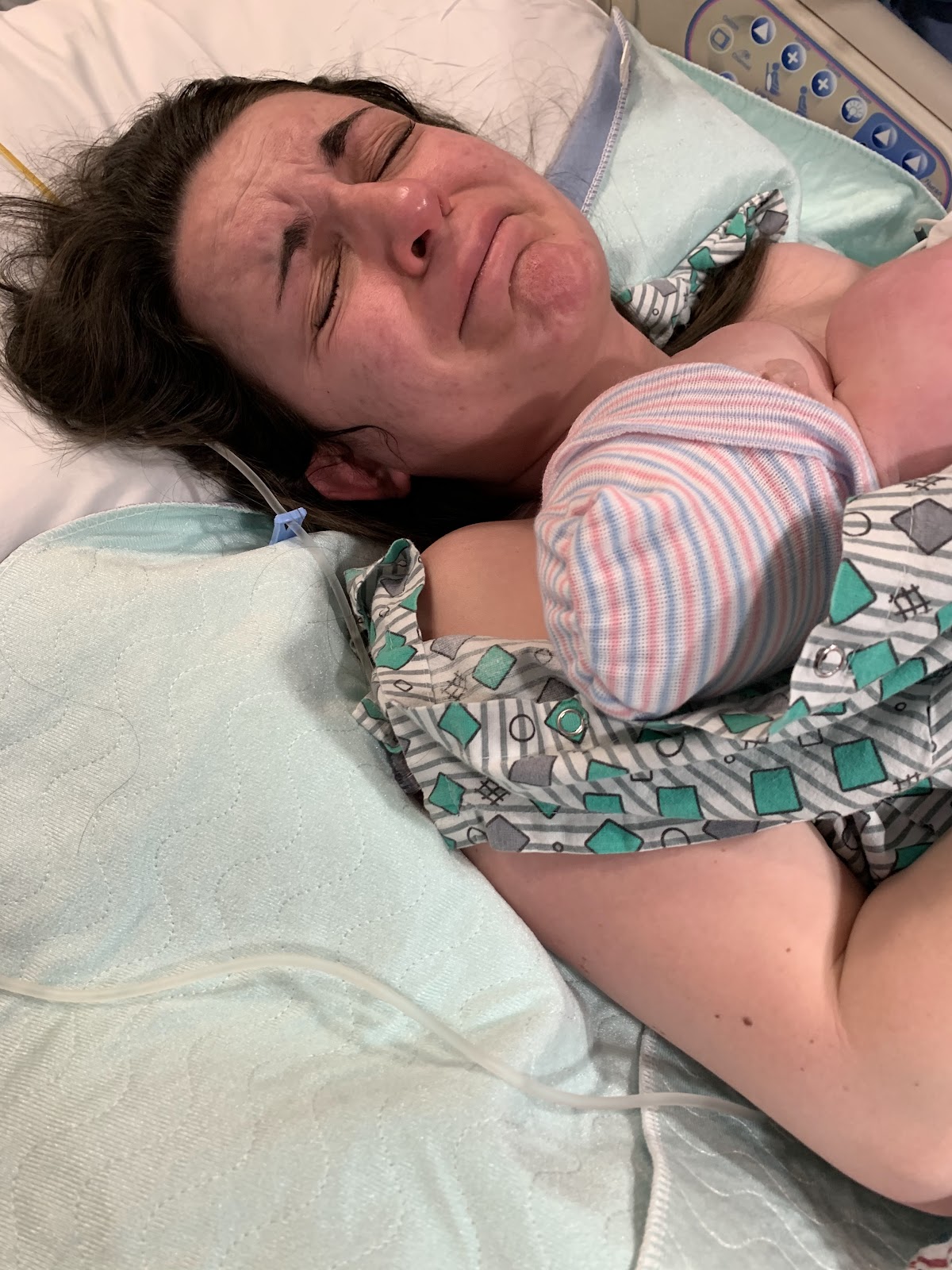
At 3:58 PM on Monday February 8, 2021, I finally got to hold my baby.
Even 2 years later, I look at her in amazement that she’s here. One day, she’ll know how much I longed for her to be here. One day, she’ll understand why we pray for her brother every night. And one day she’ll understand why my love for her runs deeper than any love I’ve ever known in my life; she was and still is, my biggest dream come true.


 A pregnancy loss blog