Pregnancy After Loss

The “Rainbow Baby” Connection

CW: mention of living children, birth, pregnancy after loss

I love a rainbow baby.

I mean this literally and generally. I am lucky enough to have a rainbow baby to love and adore.

Rainbow babies fill me with joy. They carry so much hope and have so much love in their corner. Their existence is a testament to the literal blood, sweat, and tears it takes to conceive a child.

But what if you don’t get a rainbow baby?

What if that term frustrates you?

What if the thought once gave you hope but now it’s fleeting?

What if you don’t get to find out “what’s on the other side?”

What is a “rainbow baby?”

A rainbow baby is a term used to describe a baby or a pregnancy that comes after pregnancy or neonatal loss. It is often used as a symbol of hope, just as rainbows can come after rain, like healing after a hardship.

Some people are not a fan of this term. It often gets branded as a misnomer… “why would the baby that you lost be a storm?!” Calm down, Karen. He’s not. And no one thinks that he is.

The “storm” loss parents are referring to is the turmoil, pain and heartbreak that happens after a loss. A baby is a symbol of joy, of new life, no matter how they came to be. Even parents that have experienced loss after a surprise or unplanned pregnancy or had to terminate for medical reasons still experience grief from their loss. The devastation of pregnancy or infant loss is a dark and isolating event, similar to a storm. Alternatively, a rainbow is a symbol of hope, a promise of good to come.

I love the term “rainbow baby” and use it frequently. My daughter will know what it means as a reminder of how wanted she is and how hard we fought for her to get here.

But what happens when you fight and beg and plead and bleed and fight some more and the rainbow doesn’t appear? What if the storm continues and the sky refuses to clear?

“Who said that every wish would be heard and answered when we wished on a morning star?”

This is my problem with the term “rainbow baby:” a rainbow is not guaranteed.

Pregnancy after loss is a part of some people’s stories, but not all. Telling someone it will be “their turn soon” may sound right in the moment and feel secure, but what the loss parent won’t tell you is they wonder every day when “soon” will be. When will this storm pass?

A rainbow is not a symbol of how hard someone fought for their pregnancy. It’s easy to think “since she has a rainbow baby, she did something right. Since I don’t, I did something wrong.” If you’ve ever tried to conceive a child you know that it’s not all that simple. You know how the stars, the universe, prayers, chakras, WHATEVER have to align in order to see those two pink lines.

A rainbow pregnancy does not equal success. Maybe you decide to take a much needed break in your journey. Maybe you decided to adopt or foster. Maybe you had the courage to keep going, even when you thought you couldn’t. Your “rainbow” can be whatever good comes after a loss.

“Rainbows are visions, but only illusions…”

On the same token, rainbow babies do not replace the babies that have been lost. While it is truly an exciting moment when a pregnancy after loss can be announced or a baby is born healthy after a loss, the babies that came before still exist to those parents.

Many feel like there is a timeline for grief, often convinced that there are “stages” you must go through. Once you have gone through the stages, you’re cured!

Grief isn’t a disease. There isn’t a cure. It’s something that lives in your soul, some days taking up the most space it possibly can, growing so strong and so overpowering, you feel like you might explode from the pain.

And some days, grief is simply a resident. Sitting quietly on a bench, holding the hand of its strong and more powerful friend; hope.

A rainbow baby does not replace the babies that have been lost, it is just another baby we’ll love and honor and protect as long as we live.

“What’s so amazing that keeps us star gazing and what do we think we might see?”

For some families, pregnancy after loss becomes a part of their story.

Right after my miscarriage I thought, “if I could just get pregnant again, I would feel better!”

Wrong.

Pregnancy after loss is a loss of innocence. You know everything that can go wrong. How it feels, what to look for, what is a “bad” sign, what is a “good” sign. And so many of these “bad” signs can also be just very normal things; cramps, bleeding, abdominal pain.

I’ve heard this said many times; pregnancy after loss is like holding your breath for nine months. During that time, it is a constant battle of what we “think we might see” once we hit each milestone:

“Once I hear the heartbeat, I’ll feel better.”

“Once I make it out of the first trimester, I’ll feel better.”

“Once I can feel kicks, I’ll feel better.”

“Once I get to the anatomy scan, I’ll feel better.”

“Once I make it to the third trimester, I’ll feel better.”

“Once I make it to labor and delivery, I’ll feel better.”

And the truth is, you may not “feel better” until that baby is crying in your arms.

There was a time at the end of my pregnancy with my daughter where I truly wondered if I would be taking a baby home from the hospital. Nothing was wrong, my miscarriage just taught me that nothing is guaranteed. I would start conversations with “God willing I bring this baby home…” or “assuming all goes well…” I thought about how many mothers go into the hospital in labor and come home with an empty car seat. This “rainbow” business is knowing that while hope is present, sometimes it’s all we have to pull us through these terrifying possibilities. Even though I was lucky enough to experience a rainbow pregnancy and have a healthy “rainbow baby,” it didn’t feel all that “rainbow-y” in the moment.

While rainbows are bright and colorful, a rainbow pregnancy can still be clouded with fear.

While rainbows are cloaked in sunshine, a rainbow baby can (and will) have dark and difficult days.

Just because you see a rainbow, doesn’t mean the darkness still can’t creep in from time to time.

“Why are there so many songs about rainbows?”

Someone on my Instagram shared that the term “rainbow baby” felt like “a club [they] really didn’t want to join.” I hear ya. I would like to unsubscribe as well.

Some people just hate the term. And that’s okay.

It’s not a perfect label. It is not all-encompassing and truly, it is hard to reduce the pain, suffering and love you feel if you have lost a child to one word.

Maybe you prefer “miracle baby” instead.

Maybe it feels cheesy to you.

Maybe it feels overused.

Maybe you’re “rainbow-phobic.” (Is this a thing?)

No matter how you choose to label your pregnancy or baby after a loss, that “club” (the lovers, the dreamers, and me) is always here to support you and cheer you on.

Song lyrics by Jim Henson, “The Rainbow Connection.”

Standard
Stillbirth

Blaire’s Story

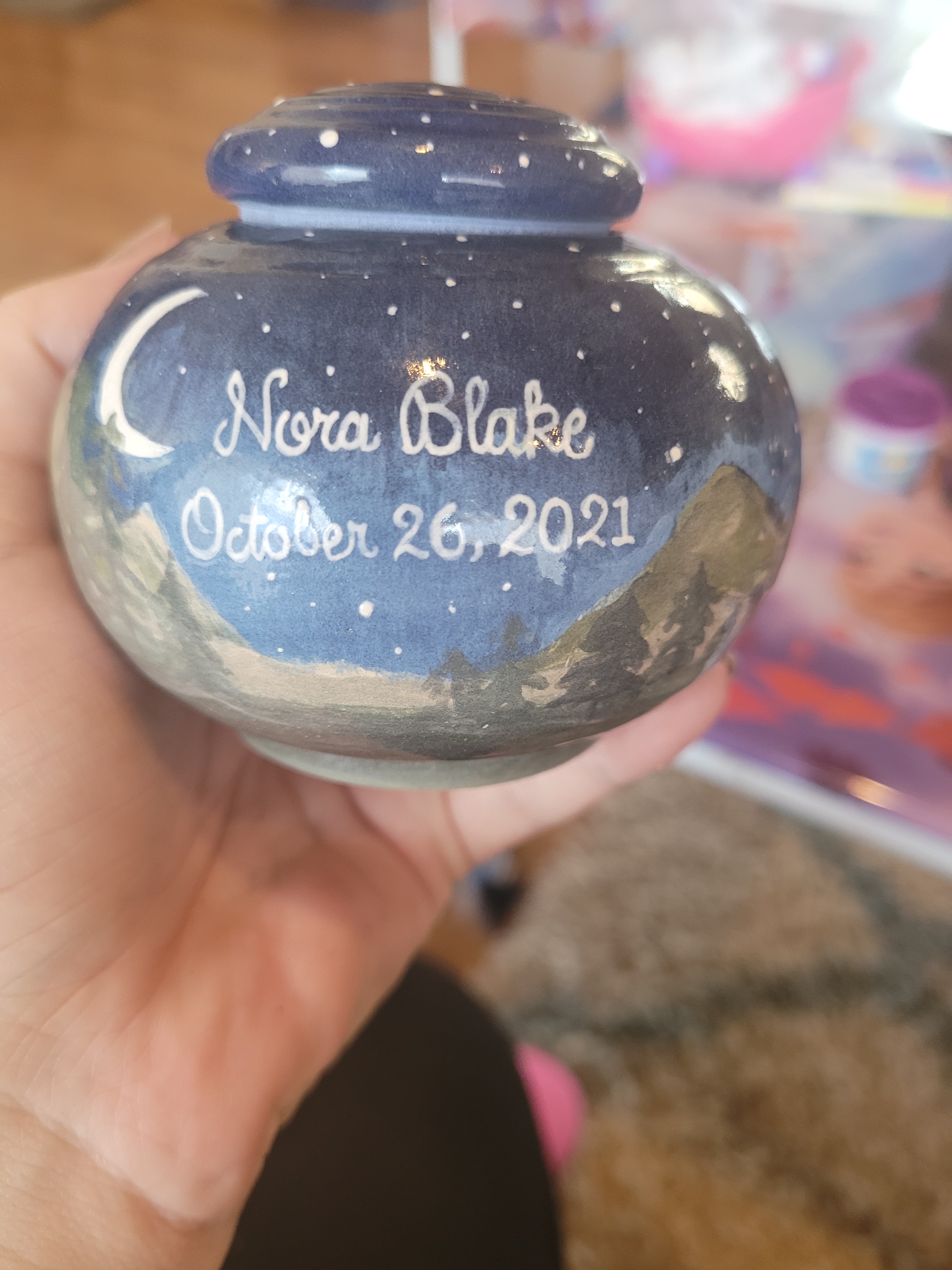
Nora

Our first daughter was born in October of 2016. I naively thought that it took “forever” to get pregnant with her, it took 3 months (insert eye roll here). It was a very uneventful pregnancy that ended with a somewhat eventful delivery. My water broke at 36 weeks and 6 days and our beautiful daughter made her Halloween debut. Fast forward through postpartum depression, moving 12 hours away from our support system, the death of close family members, and 2 years later, we decide we are ready to try for a second child. This is where our long journey to Nora begins.

In early 2019, I got pregnant and then went through a missed miscarriage. I got positive tests, faint ones, but still positive. My period was over a week late so I made an appointment with my doctor for the first ultrasound. About a week or so after that I started having bad back cramps that my doctors office dismissed as just normal pregnancy pains. The next day, I started bleeding heavily and ended up in the emergency room where I was told my HCG levels were very low and they could not find anything on the ultrasound. This was my first experience with the world of miscarriages and it was devastating. To make matters worse, when I followed up with the OB/GYN I was seeing at the time, she told me that no one really looks into the cause of miscarriages until you have had three. 

In 2020, I had my second and third miscarriages – these were also early. I made an appointment with my OB/GYN to discuss the fact that it had taken quite a while to get pregnant again and I had just had 2 more miscarriages. I was 33 at that point and worried that my age may be playing a part in everything. At that appointment, I expressed my concerns and was thankfully taken seriously by my doctor. She ran as many tests as she was able to and then referred me to a fertility specialist when all of her tests came back with no answers.

Through fertility testing, we were diagnosed with secondary infertility. What a frustrating world to be in. You’re told that you should feel lucky that you have one child at least, and everything happens for a reason. I hate that phrase. Yes, I am so lucky to have my daughter, but I also feel like my family isn’t complete yet, and would love to give her a sibling

Our fertility doctor suggested we try IUI and was pretty confident that we would get pregnant that way. We did three medicated rounds and finally got pregnant. I went in and got it confirmed via a blood test on a Thursday and was told to come back Monday to make sure my HCG levels were rising. By Saturday, I was not getting positive digital tests (yes, I continued testing at home, because I was paranoid it wasn’t going to stick) and by Sunday, I was bleeding. Monday’s blood test confirmed my fourth miscarriage. It had been 2-2 ½ years of trying and the miscarriages were just taking a toll on me mentally. I told my husband that if our next round did not work, I didn’t know if I could keep going. 

Round 4 of IUI was next and what do you know, it worked. I got a positive test about 4 days early and the lines just kept getting darker, I couldn’t believe it. We went in at 6 weeks to get our first ultrasound and saw baby’s heartbeat. I still couldn’t believe it. We also found out I had a small hematoma and I was put on pelvic rest until the next week when they would scan again. At week 7 the hematoma was gone and you could see the little heartbeat fluttering strong. I was released to my regular OB/GYN and scheduled my first appointment with them. We were so excited and started telling our family and close friends when we were about 8 or 9 weeks along. 

Blaire Graniero

I cautiously started to plan for baby’s arrival, we had a due date of February 11th 2022. I still couldn’t believe I was pregnant! I wouldn’t let myself get too excited though, because I was scared it was all going to end. We found out baby was a little girl and started thinking of names. My husband and daughter were so very excited. Then, I started spotting around 11 or 12 weeks. I thought for sure it was the end. I went into the office for another scan to see what was going on. Come to find out, I had another hematoma and was put on pelvic rest again. When I went back for a follow up ultrasound at 15 weeks, we were told it was gone. I was relieved and let myself finally get excited about baby girl. We started getting out all of our baby stuff and set up the room for her, I got the registry going, and we started narrowing down names and finally landed on Nora Blake. Everything felt right.

Blaire Graniero

My next appointment was for our anatomy scan at 19.5 weeks. Covid was ramping up again and my doctors office changed their policy about who was able to come into the office. Children were no longer allowed, and on that particular day we unfortunately didn’t have anyone to watch our daughter, so my husband wasn’t able to go. I was nervous for some reason, but everyone assured me that everything was fine and it was just my anxiety. But deep down I just couldn’t shake the feeling that something was wrong. 

During my scan I noticed that Nora wasn’t moving around all that much, but she had a strong heartbeat so all was fine. I told myself there was no reason to be anxious. Then the ultrasound tech started scanning her heart and kept scanning her heart. I tried to not pay attention to it too much and asked her if I had an anterior placenta because I wasn’t able to feel her move much. She responded that she would answer that in just a minute because she needed to keep checking for something really quick. She then told me that there didn’t seem to be a lot of amniotic fluid and she was having trouble taking some measurements, she needed to go get the doctor to double check.

Cue instant fear and tears. I was so scared in that moment, and alone. The few minutes that she was gone felt so long. Finally, my nurse practitioner came in and looked at everything. When we went back to the room I called my husband in tears and told him that something was wrong, I didn’t know what yet, but something. When she came back in the room she explained to us that there was not much amniotic fluid, there may be a hole in her heart, they can’t find her bladder and she’s also measuring two weeks behind. She was going to refer us to the high risk OB group and her nurse would try to get us in as soon as possible.

We were able to get in two days later and were met with the absolute worst news. Anatomically, Nora appeared to be fine, but there was no measurable amniotic fluid and she was incredibly small. We were told that she most likely would not survive because at that point I was only 19 weeks and a few days. We could terminate the pregnancy or continue to be monitored weekly to see if there was any improvement. We chose the latter. At that point our doctor’s best guess was placental insufficiency, she just wasn’t getting what she needed to grow, and unfortunately, there was nothing anyone could do.

Every week, we made the 45 minute drive to see our doctor and get another set of scans. Every week Nora was alive, but with little to no improvement. Every week we didn’t know if we should be hopeful or not. Every week we left our appointment with so many more questions. But every week was one more week with her, so we tried to enjoy it as much as we could. 

At one point, around 22ish weeks, we started talking about the possibility of her maybe being able to survive and receive medical intervention if I went into labor, but only if she had finally grown. Unfortunately, the scans showed that wasn’t the case. And then doppler scans of her umbilical cord and liver started showing signs of reversal. We were told we probably had a couple of days left. Nora had other plans though because she held on another week.

At 23 weeks we went in and were surprised to see her still alive. That probably sounds awful to say, but we were truly shocked when we would go in each week and she would have a heartbeat. At that appointment, her dopplers showed a complete reversal of blood flow. She was not getting anything at that point and her heartbeat was starting to slow. We made an appointment to come in the next Monday rather than Wednesday to check and see what was going on. Our daughter’s fifth birthday was quickly approaching, so we wanted to know what was going on before that.

On Monday, we went to our appointment and during my triage with the nurse, we discovered my blood pressure was high. I thought it was probably because we were anticipating Nora not having a heartbeat and all the stress of the last few weeks catching up to me. She had me sit for a few minutes and checked again; it still had not gone down. Our doctor was worried that I may be starting to have preeclampsia and told us that it was time to be induced. I was 24 weeks now. We checked into the hospital at 10:00 that night and I was started on Cytotec around midnight.

At 9:52 am on October 26th, Nora was born. She unfortunately did not survive labor though. She was so small, but she was a little person. She had a head full of hair already and looked just like her older sister. Immediately after delivery, I was started on medication for preeclampsia. Then we got to hold Nora for as long as we wanted. The hospital staff were so kind. They brought us a memory box that had a small blanket, some hats, an angel gown, a tiny cloth diaper and a few other things. They also took pictures of her, got her handprints and footprints, and allowed us as much time with her as we needed. 

On the 27th, I was discharged. I thought everything up until that point was difficult, but boy was I wrong. I had to finally face the reality that I was leaving the hospital without my daughter. I had to be wheeled past all of the postpartum rooms, and then on the way out of the hospital going to the parking deck I passed a new mom and dad getting a picture taken with the newborn. It was a punch to the gut. I had a 45 minute drive to get it all out of my system and pull myself together enough to go home and then tell my almost 5 year old that her baby sister was no longer alive. 

The next few weeks were incredibly difficult as I navigated still being a mom to a living child, having preeclampsia and constantly monitoring my blood pressure, and dealing with typical postpartum issues. We still had no answers after those first few weeks. The physical exam of the placenta only revealed that it was small and it showed some calcification, but nothing major, and Nora’s autopsy revealed that while she was very small, she was perfect in every other way. I started going back to see a therapist and trying to work through the fact that I may not have an answer to why everything happened and how to move forward. 

A few days before Christmas, we finally got an answer. The pathology report on my placenta finally came back and it revealed that I have something called Massive Perivillous Fibrin Deposition. The very basic explanation is that there was a bunch of “gunk” around the villi on my placenta and it prevents blood flow. It is an extremely rare condition and there is very little known about it. It appears that it may have a pretty high recurrence rate and there is no known cure to prevent it from happening. I am glad to have an answer, and to know that I truly did nothing to cause this. It is a scary answer though, and we do not know what things will look like moving forward, but for now it can help us get a little bit of closure. What I do know right now is that we are a family of four, and even though Nora is not physically with us, she will always be known and have a presence in our lives. We hope to be able to share her story with other families so they know they aren’t alone, because a journey like this definitely feels isolating and lonely. 

Professional photos courtesy of 84W Photography.

Standard
Miscarriage

Emily’s Story

Hazel

It’s no surprise that 2020 was a difficult year for me as well as many other people. In October, my grandfather was diagnosed with Covid and four days later he died.

I found out the Friday before Thanksgiving that we were pregnant, and I was actually kind of shocked because it had taken half the amount of time to get pregnant as it did with our son. I am a religious person and I most definitely thought that this was a gift from my grandfather to us, something to get us through the heartbreak and a baby that we had hoped and prayed for.

 A week after I found out that I was pregnant, confirmed by blood test, I had started to have some bleeding. I didn’t think that anything was out of the ordinary considering that I had had bleeding with my previous pregnancy. I had an ultrasound done to confirm everything was okay around six weeks and two days and was told that I would follow up in two weeks for another ultrasound. Those weeks were stressful leading up to the next ultrasound but I truly believed that everything was going to be okay. The night before my ultrasound I found out that our son was a close contact of a Covid positive person at daycare and would be quarantined through December 26. That was devastating because the thought of even gathering for Christmas was off the table at that point. I knew that I had to go to the ultrasound. I knew that I needed to have it done or else I would go crazy for another week and I wasn’t a close contact. 

I went to the ultrasound and the ultrasound technician was making small talk with me asking me about my previous pregnancy, what I was doing for the holidays, small talk. Once she was finished she told me that she had to have the radiologist take a look at the images because it was a follow up ultrasound. I remember thinking that this was strange because the last ultrasound they called me to let me know the results. I also just had a feeling something was off. Call it “mom intuition,” if you will. The radiologist came in and looked at the images. The ultrasound technician gave him my gestational age and he took a look again. He looked at me and said, “There is a little baby in there, but I’m so sorry there’s no longer a heartbeat.” The fetal demise was most likely five days prior. These are words you never forget.

The ultrasound technician was really sweet and she told me she already had Covid and if I wanted to take off my mask I could. She told me that I could get dressed when I was ready and she would go talk to the doctor and see what the next steps would be.  I got dressed and attempted to use the phone in the ultrasound room to call home and tell my husband that I would be a little bit later because the baby was dead.  After some time the technician came back and said my doctor was out on vacation through the new year and a different doctor would see me.  

I had to sit in the waiting room because there were no empty rooms for me to wait in. I’m sure that way it would’ve felt really long regardless of how long I actually waited but I waited roughly 30 minutes in the waiting room bawling my eyes out. Near pregnant women, new babies. When it was finally my turn, the medical assistant wanted to take my weight. I asked her if it was really necessary. She added that I could pass but it would be charted as a weight refusal. I told her I found out my baby is dead and you want to take my weight. She told me she didn’t know why I was there as I was just added to the schedule and that she was sorry. 

I waited in the room. I don’t know how long for the doctor to come in. I wasn’t on the schedule and clearly they fit me in. I don’t recall much of what he said except for it’s very common, and there’s nothing I could’ve done that caused this. He told me that when you have a miscarriage you basically have three options: you can wait and see what happens, take medication to cause you to miscarry or you have a surgical procedure most commonly known as a D & C. He went over all the risks of all of three and honestly, I was scared to death and I was sitting in a room all by myself having to make these major medical decisions without anyone that I know and trusted to confide in. Partly because of Covid and the thought of being in a hospital for surgery scared me as well as the risk factors I chose to wait and let it happen on its own.

A week and a half later I went in for repeat lab work to measure the progress of my hCG dropping. It was still at 40,000 units. I really just wanted to talk to my doctor that I knew and trusted about all of this. He did call me back once he returned to work and it was decided we’d have a follow up appointment in a week. Because of Covid, it was a virtual visit and my mental state was spiraling.

I couldn’t sleep, couldn’t stop crying. I kept thinking that maybe they were all wrong. I felt like my body had failed me again by not letting go of this baby.

We decided that we would take the medical management route. That day, I picked up my prescription and I would take them on Saturday. My doctor wanted me to be off of work for two weeks. I thought one week would be enough time and I had a bonus day off for Martin Luther King Jr. Day.

I had to take the pills every four hours until they were gone. The first two pills I had to stick up my vagina and would repeat that until I started bleeding. The pills were a hexagon shape and I could feel them scrape me inside as I put them inside. An hour later, I started to bleed. The pain was so excruciatig. Anyone that tells you it’s like a heavy period has clearly never had a miscarriage before. While I was given pain medication, I didn’t take it as it makes me feel weird and I don’t like that feeling.

I found a text message recently that I had exchanged with one of my friends and described the pain I felt the day of my miscarriage to feeling like death. It’s kind of fitting because part of me did die that day.

I scoured the Internet for 2-3 weeks trying to figure out when it would happen and what it would feel like, how would I feel, what would I experience and was left with little to no luck. I felt so alone physically and was alone except for my immediate family because of Covid. I think that’s part of the problem with miscarriage, that we feel so secluded.  Unless you’ve had one you don’t understand what we go through and will go through for the rest of our lives. I knew of people that had experienced pregnancy loss before me and I didn’t think it was a big deal. I know now that I was very wrong. 

It was a couple of months after the fact that I felt very strongly about how I was treated as a patient in my encounter the day I found out and in subsequent lab visits. I felt that the system was flawed within the hospital. I had completed the survey after my visits but never had heard anything from anyone regarding my concerns. That bothered me and it wasn’t until I read a book about baby loss and the writing prompts in the back asked what you wanted to change post loss. This experience was what I wanted to change. I couldn’t have my baby back but maybe we could be given some dignity and compassion while we are having our hearts ripped out of our body. I would be lying if I didn’t say that I thought nothing would happen because how could I make any change happen.

After submitting my complaint to the hospital, a week later I received a phone call from the manager of the department wanting to find out more about my story apologizing for everything that happened. Over the course of a month or so I received three or four phone calls from her with updates on their improved protocol and steps that would occur when someone finds out their baby has died. I literally cried when I read the email of all the finalized steps that they had taken. Going so far as to have baby free rooms for patients to wait in. No one needs babies all in their faces during that time. Honestly, I was a little bit angry with everything. I wished somebody would have done that before I had ever had that experience, but was happy knowing that it would be a bit easier on those experiencing baby loss.

I connected with many miscarriage accounts on social media after my miscarriage. Many had said it would get better with time though it doesn’t feel like it now. I didn’t believe it and never thought I’d ever get out of this brain fog while the whole world continued on around me. Flushing your fetus down the toilet feels awful. I recall saying hello and goodbye and hesitating to flush. I was angry that I didn’t know that there was another way, that I could’ve done something differently.

Through my interactions with the hospital, I was connected with one of the chaplains. She was a lovely woman and the first person I felt true compassion and care for our situation and through everything I endured at the hospital. They do a communal burial of all the babies lost too soon (with parental consent). She allowed us to bury momento of our choosing even though our baby was not physically present. I finally felt that my baby’s was honored and would be remembered. The memorial service was perfect and touching and I cried through the entire thing. I wished I didn’t have to be watching it but was happy that someone finally was allowing us to grieve in a more normal way.

Shortly after this memorial service happened I had a dream. In my dream my grandfather was there and he was with a little girl.  He told me that he was now 97, four years older than when he died.  The girl was four years old and he explained that this was our daughter. We didn’t know if we were having a boy or a girl. Dreams are strange sometimes. I had no idea if this was a sign of a future daughter or our baby that had passed. It seemed more logical that because my grandpa was dead that this was our daughter that left us too soon. My husband and I decided to give her a name, one we had agreed upon shortly before my miscarriage. 

It’s a few days away from her “first” birthday. I’d give anything to have her here with us. But know she is smiling down on us, proud of the work we’ve done to make things better. My sweet Hazel, I hope you know how much I love you.

Standard
Miscarriage

Lindsey’s Story

It was the last day of September.

The fall weather was attempting to come out, the bees were finally going away, I was two months into a new position at work that I loved, and everything was okay, until it wasn’t.

I knew it wasn’t when everything was red. Red and alarming. A color you don’t want to see in early pregnancy. My least favorite color. The sight of it made me dizzy. I grasped on to one tiny spark of hope that it was a fluke, and that maybe, somehow, everything would be okay. But it wasn’t.

In a whirlwind that felt like hours my husband was in the school parking lot to pick me up. Parents had already started arriving for dismissal and I remember leaving quickly and quietly, so as to avoid small talk with them.

Then there were nurses, pads, IVs, BP cuffs, ultrasounds. No answers. Just questions. The same questions on repeat. Don’t these people communicate with each other?
“How far along were you?” Their use of past tense in this question struck a nerve with me. It was tactless, and confirmed what I already knew to be true.
“When was your last menstrual cycle?”
“When did the bleeding start?”
More questions, more notes typed into my file.
What seemed emergent to me seemed like another day on the job here.

“Wait back out in the waiting room until we get a room ready” they said.
So I sat there, in a chair on top of my folded up cardigan because I had bled through my pants. I stood in line at the front desk to ask for a few more pads. Why would they send me back out here without one? I was embarrassed and frustrated.
I waited, anxiously, for the door to open and for them to call my name.
I started to accept the situation, that the baby I had grown to love was no longer nestled safe and snug inside my womb.

Why? “Don’t blame yourself” they say. This is difficult to do when you find yourself questioning every decision you could have, should have, would have done differently.

5 minutes turned to 20, then 20 turned to 40. The nursery chimes played on the hospital intercom to indicate that a baby had been born. Tears soaked my mask as the realization hit that someone else was celebrating their miracle at the same time that mine had slipped away. For the first time since the pandemic started, I felt an ounce of gratitude for the mask that concealed my sorrow from the strangers in the room. My husband grabbed my hands and we sat in solitude. Just the two of us, when it should have been three. I thought about that scene from UP, where Carl holds Ellie. I was grateful that I had my own Carl. I felt sad for him, having to grieve our loss while watching me in pain.

I was sent home with nothing but a written excuse to be off work. I felt empty, in the worst of ways.
The days that followed that night in the hospital were dark, and despite the outpouring of love, support, and gifts from loved one, this was the loneliest I’ve ever felt.

Friends and family said every combination of all of the right and wrong things. Some said nothing at all.
I thought of the irony that it would be my luck to lose my baby the day before Infant and Pregnancy Loss Awareness Month. I tried to busy my mind with social media and quickly shut that idea down when every other post violently reminded me that my body expelled a baby that I very much loved and wanted. I didn’t need awareness for the new hell I was succumbed to.

I wondered how long it would take for me to be happy for pregnant friends? How long will this sting for when I hold a new baby, or shop for a shower? How long will I wonder who that sweet baby would have been? How my girls would have loved them, what they would have looked like, what name we would have chosen. How long will I be bitter, sad, and unapologetically pissed off at what could have been? How many times will I shake my fists and wonder why this happened to me? Will I ever be brave enough to try again?

It’s common, to lose a pregnancy. 1 in 4. I now fall into the “1” category. Why, I wondered, is it still so difficult to talk about? Why is there still a stigma associated with miscarriage?

To those who have walked this same path before me, I’m sorry if I didn’t say enough or do enough to support you. I didn’t understand then, but I do now. To those who walk this same path with me, I am here for you. To those who will walk this path after me, it’s not your fault. I share this, because even though it’s vulnerable and emotional, my loss mattered and my baby mattered. If I can help someone else heal or talk, even in a small way, then I’ve made a difference.

Thank you to my support system for being a light in the darkness. And to my beautiful girls, for giving me a reason to pick myself up and keep on going. I needed to feel needed, and I needed to stay busy, my children are perfect for both of those things.

And so I’ll grieve, in whatever way feels right. I’ll allow myself time and space to feel whatever I need to feel. And I will pause and remember my sweet baby, who only knew love.

Standard
Coping With Loss, Miscarriage

Dear Pre-Miscarriage Me,

Hey! How’s it goin’? Been a minute…almost two years to the date since we’ve been together.

I’ve been meaning to write you to see how you’ve been, but it’s been a little hectic. These two years have gone by so slowly but simultaneously have passed in the blink of an eye. “The days are long but the years are short,” they say. But we’re not really into clichés, so I’ll just cut to the chase.

I don’t want to give too much away, but I know what you’re wondering, the only thing you’ve cared about since May of this year…do we have a baby yet?

The answer is yes.

Just not the one you’re pregnant with.

I know, this is so hard to hear. I am so sincerely sorry.

I want to tell you that there wasn’t anything you could’ve done to prevent this, even though deep down, I think you already know that. Still, in the moments in the upcoming weeks when it’s easy to think “maybe if I didn’t exercise” or “maybe if I drank more water” or “maybe if I ate less gummy worms and pancakes,” the answer to “could I have changed this outcome” is, and always will be, a resounding “NO.”

I want you to know that your intuition was right; something wasn’t right. You knew all along. And that is because you have been a great mom since you saw that positive test a few weeks ago.

You’re going to go through a lot within the next two weeks. There will be a lot of miscommunication, pain, and brief moments of hope. In these brief moments, really take a second to look around you and appreciate how you have immediate access to everyone you need: Preston. Mom and Dad. Your family. Stella. You were in the right place. This isn’t a coincidence.

Some of the interactions you have within these two weeks will define the trajectory of your life for the next few years. I know, heavy stuff. We don’t need to focus on that just yet, things are heavy enough these days…(speaking of, just a heads up…might want to stock up on disinfecting wipes, hand sanitizer and face masks. Oh, and toilet paper. Don’t ask questions, just do it. 2020 gets weird.)

What I want to focus on is the woman you’re about to become.

I want to tell you how you started those two weeks as a woman carrying a baby but ended them as a true MOTHER. Someone who did everything she could in her power to do right by her baby. Someone who fought for answers and worried and prayed for her baby’s well-being. Someone he would be proud of. (You always thought it was a he, didn’t you? Spoiler, we stick with this and name him Anthony. Yes, like Grandpa. Cute, huh?)

I want to tell you how your strength came through. For your husband, for your family. For the baby that slowly exited your body, not wanting to let go just yet.

You didn’t want to let go either, mama. I know. I still can’t let him go even now. I’m not sure we ever will.

You’ve taken this pregnancy in stride. Your pregnancy journal, weekly bump pictures, and contact with medical professionals was all the right thing. You’ve always done the right thing.

I see the dreams you have for him slipping away as your nausea decreases. Deciding on which room to transform into a nursery. Thinking of the shelves Preston will make for his books, the onesie he’ll wear when you take him home from the hospital. The years we’ll spend celebrating his birthday at the beach because it will fall during our family beach week.

In a few days, you’re going to tell your high school friends that you’re pregnant. You’re going to give them homemade ornaments that say “the best friends get promoted to aunt” and they’ll scream and flood you with hugs. This will be the last sure announcement you give for your pregnancy. (Those friends will still hang that ornament on their trees in years to come. Not that this will surprise you, they always show up for you. I can’t wait for you to see how other people show up for you, too.)

You’ll stop feeling sick abruptly. You’ll bleed. You’ll cry. You’ll go to the ER. Doctors will make you wait and lack compassion. You’ll cry some more. And then, you’ll wait.

And wait.

And wait.

Until a week goes by.

And the waiting ends.

And so does your journey in this pregnancy.

But in this, something is born.

What begins is the mother you’ve become,

With the strength and fierce love for both of your babies;

One in your heart,

and one in your arms.

I am so, so proud of you, Britt.

So is he. And so is she.

We all love you,

Britt, December 2021

Standard
Coping With Loss

Pregnancy Loss: A Holiday Survival Guide

Funny story.

I started to write this post in my head weeks ago. Not only had I recently experienced a holiday season after pregnancy loss, but I had actually had a miscarriage during the holidays. Who better to write about surviving the holidays after loss than someone like me?

Well, if you ask my imposter syndrome, it’ll say “not me.”

I started to doubt myself. How are you supposed to write about surviving the holidays after loss when the only way to do that is to fight tooth and nail through every moment, every event, every memory to not think about the person (or people) that you just want here?

Christmas is literally centered around children. The hope, the wonder, the anticipation. The true meaning of Christmas is centered around a baby. Christmas is essentially a holiday for children, made possible by mothers. To not think of the baby you lost is near impossible.

This is why this is a survival guide.

Sometimes you don’t cherish every moment during the holidays. You don’t lean in to being “merry and bright.” You don’t watch every movie, or receive every present on your list. Sometimes you just are present. And that’s okay.

Sometimes surviving the holidays after pregnancy loss is just that; surviving.

So if that was enough, no need to go on, dear reader. But if you could use a few more suggestions for your back pocket, this survival guide is my gift to you.

____

When your family doesn’t acknowledge your loss:

Sigh.

If I’ve said it once, I’ll say it 5,000 times:

You cannot, and will not, remind a bereaved parent of their loss.

They’re well aware. Avoiding bringing up the baby’s name, absence or sheer existence deepens the misconception that pregnancy loss should be kept silent. But I don’t need to tell you that, do I?

  • talk to your family in advance: I’m a big boundary-setting girl. Send a text ahead of time; “hey, I know everyone might feel uncomfortable talking about Jack, but I’m having a hard time without him and it helps me to talk about him. Please feel free to check in at dinner tomorrow.” They might need your lead on this one.
  • set the stage: speaking of, you might have to be the one to spearhead this conversation. Being open and truthful when people ask you how you are can give them the signal that they need to step in or even be more present.
  • give them grace: I know, not what you want to hear. If you’re close, remind yourself that they’re most likely grieving too. They might be too involved in that or simply don’t know what to say to you. I have another post on that here (maybe send it in the text in advance??).

When you see “happy families” on social media:

The quotes are there for a reason.

What you see on social is a highlight reel.

What you don’t see in McKayleigh’s “perfect” family photo is the bribery, screaming and wardrobe malfunctions between her 3 cherubic-looking children and a handful of “tiffs” (because they don’t fight, reader! They’re just so solid! He is her rock!!! I digress) with her husband in the middle of it all. Somewhere in this mass chaos, the photographer got everyone to look in the same general direction, and boom – you have a Christmas card. (Also, photoshop helps.)

—-

Recently, a co-worker I just met told me she was pregnant with baby number 3. Since she was so lax about sharing her 4 week old pregnancy with a borderline stranger, I quickly assumed she had the luxury of going through both of her prior pregnancies without worry.

“It’s so unfair,” I said to a friend later as I scrolled my co-worker’s Facebook, “some people just get to get pregnant and know they’ll get a baby out of it. I seriously wonder what that feels like.”

I came to find out that this co-worker indeed was not only worried about this pregnancy (honestly shameful I ever assumed otherwise – everyone worries about their pregnancies), but also had suffered a miscarriage at 7 weeks with her first. I found all of this out because she started spotting at work and confided in me.

Excuse me while I eat my words.

All this to say, if you think you know what someone is going through, you don’t. These families you see online have stories behind them you would never expect.

So when you see that Christmas card with the 3 babies and that rock-solid hubby, who knows? They might be trying for another baby, going through IVF, or reeling from a loss…just like you.

When you feel guilty celebrating the holiday without them:

I want you to think about the sweet baby you’re missing. Maybe there’s one. Maybe there’s few all hanging out together.

Now, think of these babies and how they only knew your body as their home on earth. How they were comforted by your voice and your touch because that’s all they ever knew.

Think of how much they love you just because of what I said above. (Because it’s true, mama! They’re your babies!)

Now, imagine your baby watching you refuse to enjoy these moments of happiness, especially during this time of year. You are allowed to miss them, this is 100% true.

But to stifle your own joy because you think you “shouldn’t” feel happy is an unnecessary expectation to put on yourself. Your babies love you. They want you to find joy again.

Remember them AND put up the decorations.

Remember them AND go to the holiday party.

Remember them AND get together with family. Odds are they’ll want to be remembering them too.

When you just want them here:

Cry, scream, punch pillows, throw the eggnog (jk, be careful), whatever you need. Then take a breath and find a way to make it feel like they’re here:

  • hang an ornament or a stocking in their honor: This is a great way for families to include angel babies in their traditions. I have an ornament with Anthony’s ultrasound picture and a wooden ornament with his name on it close to each other on the tree. Sometimes I’ll hold my daughter and show her the picture as we pass the tree and say hi to her brother.
  • do some good: donate to a charity in their name, do random acts of kindness, go out of your way to compliment someone; whatever it may be, spreading kindness when you feel hurt can turn your day around and hopefully turn someone else’s day around too.
  • talk to them: sounds creepy, but I promise it’s worth a shot. I talk to Anthony when I’m in the car sometimes. I fill him in on what’s going on and how much I miss him. It hurts and I usually end up crying, but I realize in the end it’s because I needed it somehow. A moment of connection with your baby and the opportunity for a little peace.

So whether you’re facing your first holiday season without your baby or your 30th, be sure to take care of yourself and give yourself space to grieve. Step out if you need to during events and know that some days will be harder than others. And if all you’re doing is surviving the last week of December, trust me when I say you are not alone.

Merry Christmas, mama.

Standard
Coping With Loss

What to do (and what not to do) when someone you know loses a pregnancy

“What do I do if someone I know is having a miscarriage?”

“What do I say to my friend who just had a stillbirth?”

“My sister-in-law just lost her baby and she won’t answer my texts…what should I do?”

Every year, I answer anonymous questions on my Instagram that people have about pregnancy loss. I do this in honor of my son Anthony on his due date, July 25. For every question asked, I donate to charities that support families going through baby loss.

The number one question I receive: “how can I support someone experiencing pregnancy loss?”

This is quite beautiful to me. Instead of the opportunity to be nosy about my personal experience (nothing is off limits. What can I say? I’m an open book), people choose to look inward and say “how can I do better by my friends and family?”

Speaking from experience and from what I have seen from others in this community (the community no one asked to be a part of), I’ll do my best to illustrate your options of what to do – and what not to do – if someone you know loses a pregnancy.

DO: text them

PLEASE, oh, for the love of all things, please SAY SOMETHING.

You are not reminding them of their loss. They are quite aware, and the loss hurts. And you know what else hurts? When your friends or family act like you didn’t just lose your child.

If you’re unsure where to start, try these:

  • “Hey, I heard about what you’re going through. I will never pretend to understand how you feel in this moment, but please know that I’m here for you when you’re ready to talk.”
  • “Know that I’m thinking of you and your baby. If you ever want to share more about them or your experience, I would love to listen.”
  • “I am so sorry for your loss.”
  • “Sending you love. I’d like to stop by this week if that’s okay?”

If and when they respond, you can go from there. Maybe they will want to divulge more information. Maybe they will ask to speak to you another time. Maybe they will say “thank you” and nothing else. What I can promise you is that they will not forget that you reached out.

DO NOT: stay silent

I understand that wanting to give someone space during a loss is tempting. You don’t want to overwhelm them with yet another reminder, and yes maybe they are overwhelmed. However, this loss is already so silent and isolating. It happens in 1 in 4 pregnancies, yet it still is a taboo subject, meaning birthing parents often suffer in silence. These families didn’t just lose a baby, they lost the dreams and plans that immediately spring to mind when you see those two pink lines. Just because their baby didn’t make it earth-side, doesn’t mean it’s forgotten that easily.

DO: be of service

I wanted to say “DO: send gifts” but I felt like that was missing the point.

Don’t get me wrong; many people sent us gifts after our miscarriage and they were some of the most beautiful gestures of kindness. A close friend sent me a necklace with the July birthstone on it – the month Anthony was due. Another crocheted a baby blanket (a gesture of hope) and shared a note saying she prayed for us and Anthony as she made it. My best high school girls sent me records of our favorite artists and gift cards for take out. These things meant so much and lightened the load of grief ever so slightly, and most of all, reminded me that people cared about and loved Anthony even though they had never met him.

But what I truly mean by “be of service” is showing up in person or in any way you can.

Meals

Make something and drop it off or send a gift card. Or, tell them to pick a night and restaurant and get it delivered to their house. This is my favorite because the parents can pick what they have a taste for and limit interaction, especially if they’re not ready to be with people yet.

Clean

Grief can be paralyzing. Staring at a messy house can add to stress and when you just can’t muster the energy to do something about it, it’s even more defeating. Offer to stop over and do some laundry or dishes. Please note that if you do this, don’t expect them to either a. say yes or b. open up about what happened. While this could be a good opportunity for the grieving parent(s) to share, they may not be ready. You offering to help is huge in itself and will be appreciated, no matter how big or small the contribution.

Be Present

If they have older living children, offer to babysit while the grieving parents nap or go out. If they sound like they need a friend, give them a call and offer to come over. Sometimes it takes a “I’m free Saturday at 1. Would you like some company?” or even a “I’m coming over tomorrow at 5 with dinner. Text me if you’re not available.”

Simply being present for a friend or family member going through pregnancy loss is the best gift you can give them, because your presence in their time of need says exactly what they need to hear: their baby matters.

DO NOT: overstay your welcome

If you do reach out and drop off a meal or offer a service, read the room. Do they seem like they want you to stay or do they want to be alone? Are they ready to talk about what happened or do they want a distraction? Do they have a greater need than you thought or do they actually seem to be managing (as well as one can in these circumstances)?

DO: listen and offer support

A few weeks after my miscarriage, two of my friends close by arranged a girls day for the three of us. I knew the timing was not a coincidence, but took solace in the fact that they would respect whatever boundary I set about sharing about my experience. If I kept silent, they wouldn’t push. If I wanted to talk, they would listen. I decided to take stock of my feelings once I got to my friend’s house the day of and go from there.

We sat down in her living room and something got brought up, closely related to how I was feeling postpartum. Here it was, my moment to decide. I said “guys, I feel like I just need to go through it all and tell you everything that happened.” They said “okay,” and I did.

These two amazing women – one a mother of two, one a newlywed – sat and listened to my whole story. They were silent for the most part and interjected when they knew appropriate, asking questions or calling people out that misguided us in our experience. They cried for me. They cried with me. They cried for the baby they didn’t get to meet.

This experience was so cathartic and I am grateful to them and their friendship in that moment when I needed them most.

On that note, a brief PSA:

It is not mandatory to share about your loss.

I want to be very clear: even though I fully support birthing parents and families sharing their stories in order to lessen the stigma of pregnancy loss, it’s okay to not feel comfortable talking about it, or not to talk about it ever! If someone you know who has experienced pregnancy loss feels this way, please respect that boundary but still find a way to be present for them that’s more appropriate to their situation.

DO NOT: give cookie-cutter advice that negates their feelings

Ah, well-meaning advice.

The biggest culprit of why people don’t say anything at all is because they don’t know what to say. This is fair. Grief is tough, and to be honest, kind of intimidating to talk about. Saying the wrong thing feels like adding salt to the wound which is never our intention. However, there are a lot of things that sound like good advice or the “right thing to say” when in reality, they can be twisting the knife.

“Everything happens for a reason.”

Do you really want someone who just lost a child to think that there was a reason for this to happen? Let alone a good one? Not gonna blow over well.

“It was just God’s plan.”

As someone who would consider themselves religious, I have a hard time thinking that God excites in taking children away from their parents.

Do I believe Anthony is with Jesus in heaven? Yes.

Do I now believe that there was a “reason” for the loss experience we had? I suppose, because some good is coming from it.

Would I rather have Anthony here than all of this? Abso-freakin’-lutely.

Telling a grieving parent that it was” God’s plan” to lose their child not only makes God out to be malicious (in my experience, He’s a pretty forgiving and loving guy) but also is a statement that retracts hope from future pregnancies, insinuating one child had to “sacrifice” themselves for another.

“Do you think it’s something you ate/did?”

Say it with me:

THEIR

LOSS

WAS

NOT

THEIR

FAULT.

Do I need to say it again?

Okay, I will for my loss moms:

YOUR LOSS WAS NOT YOUR FAULT.

You did not hurt your baby.

You did everything right during your pregnancy.

Nothing you could’ve done could’ve saved your baby – because if there was something, you would’ve done it. You’re a mom.

End of discussion. Next.

“At least” statements like “at least you were only ____ far along,” or “at least you can drink again!”

“At least” means nothing. We would give anything to feel sick again, to not be able to drink or eat lunchmeat, to have our bellies growing and expanding over missing our babies.

It is gut-wrenching no matter if they were 4 weeks along or 40 weeks, and no loss is “worse” or “easier” than any other (more on that in a later post). A loss is a loss.

DO: remember their baby

Remember anniversaries/birth/due dates as if it were an earth-side baby

My friends and family call and text me on Anthony’s due date. While he’s not here physically, it feels like he had a greater impact with a tangible day to celebrate him and all that he means to me.

Say their baby’s name (if they named them)

If they decided to name their baby, use it. It’s not a bad word. Saying their name also says “your baby was here, they were real.”

Another brief PSA: it is not a requirement to name your baby. Ask the parents what they call their baby, if anything. Again, follow their lead.

Acknowledge their pregnancy

If they have living children as well as a loss (or multiple losses), ask about all of their pregnancies. Pregnancies that end in loss still can be perfectly “normal” and have the typical symptoms that birthing parents love to compare (“were you sick? Oh, I was MISERABLE with my first…my second not so much” etc.) While both of my pregnancies felt similar to start, my cravings were different in both. I always like to share that when discussing my pregnancies, but never know how much is too much for someone else to handle. Acknowledging each of their pregnancies includes their angel babies in the conversation, creating a safe space for sharing.

Check in

Grief doesn’t end after a few weeks.

Check in a few weeks after. And a few months. And a few years. And maybe a few weeks after a few years. Get where I’m going with this? Grief is ever-evolving and shows itself in the strangest (and sometimes terrifyingly unexpected) ways, especially after the shock starts to fade and reality sets in. Bereaved parents may need you long after the dark days of their loss.

The bereaved parent you know may have been great yesterday but saw something on TV that made them think of their baby today.

They may be pregnant after loss months later, yet are still afraid to use the restroom in fear they’ll see blood again.

Their angel baby should be 22 this year but they had a dream about them and imagined what they would have become.

Dropping in with a text, phone call or even a letter or a card every once in awhile could be just what they need to continue to cope on a daily basis.

Read the room; follow their lead on how much they want to share

Everyone grieves differently. This advice is not one-size-fits-all. Some people choose not speak of their loss at all. Some are open books. Some need time. Wherever your loved one is, meet them there. Come from a place of love and support and you can’t go wrong. Above all, say something. The “wrong thing” can be forgotten, but the thing that hurts the most is when nothing is said at all.

Standard
Our Story

Our Story

Part 3 of 3

Life Without You

Preston and I opted to have our baby’s remains put in the new cemetery plot for the hospital network. While we knew our baby was gone, we felt that having a final resting place for our son suited the harsh situation we were facing. We were thankful we had that option and looked forward to finding closure visiting the plot with the service promised.

I contacted the cemetery the Monday after my procedure to get information. They gave me a cookie-cutter response, and when I asked when my son’s remains would be sent to the plot, they instructed me to call the hospital and speak with them.

I was connected to a woman in the nursing supervising station who assured me I would be contacted when my son’s remains were sent to the plot once it was finished. This option was brand new and was still getting finalized at the time. When I hadn’t heard in a few weeks, I called the supervising station again and they told me that she “wasn’t who I should speak with” and connected me, a mother who just lost her baby, to a nurse in maternity

You read that correctly.

I reluctantly tried to leave a message with that nurse with no returned call. Not that I was surprised. Why on earth would an L & D nurse have the time to speak to a woman wondering where her baby is? They have babies to deliver. I, on the other hand, did not.

I followed up with the hospital weeks later and asked to speak to this mythical maternity nurse apparently in charge of this plot. The woman who answered told me I couldn’t speak with her because she was “busy with a mom that is in labor, awaiting delivery!”

Gut-punch. 

I hung up, feeling my heart start to race in frustration. Why would no one answer my calls? Why would no one call me back? Why would I be calling about a cemetery plot for pregnancy loss and someone would think it’s okay to talk to me about a baby being born?

I want to say that I called the hospital every day, and that I was “that mom” that asked to speak to the manager and did everything I could to ensure I would know the second he was sent over. But I didn’t. I was grieving and trying to get back to my normal routine, which helped tremendously. But, I also trusted what people told me. My entire pregnancy, I relied on the professionals that were dedicated to doing their job and trusted their word. 

A month later, I called the cemetery to find that our baby had been sent to the plot and buried a month prior along with a bi-annual service, and no one had contacted me.

My son had been buried for a month. And no one told me.

That weekend, defeated and hurt, Preston and I swallowed our pride and went to the cemetery. After more phone calls, we were finally told where we could find the plot at the cemetery 30 minutes from our home. We stopped to pick up flowers and quietly made the trip.

The large cemetery spanned for miles up a hill. Snow was melting from the unusually sunny February day. Our shoes squished in the slush as we made our way to the “infant section.” 

As if searching for the plot of your miscarriage isn’t enough, walking through an infant cemetery is, to put it lightly, brutal. Small graves, small spaces in between. My heart ached. There were too many. 

We began the task of scouring the ground for the plot that “belonged” to us. While we were looking, a mini-van drove up. The automatic doors opened, and out spilled a family with many small children in primary-colored jackets with security blankets and stuffed animals in tow.  Their mother, slinging a diaper bag on one shoulder and holding a toddler on her hip called to the crew, “okay guys, say hi to your brother.” A little girl ran up to the tiny grave and touched the stone. A little boy ran around in the open grass, too young to understand where he was. I choked back a sob.

We continued to walk up and down the rows, holding our breath for the moment we would find the plot and our son would be found. His only presence on this earth outside of my own body.

The plot wasn’t there.

Months passed. Again, I had to step away. More calls made. More frustration. More pleading to the hospital to do better by the women and families. They tried to make up for lost time by having a special private service with a Chaplain in Anthony’s honor. We were going to be moving across the state by then. Too little, too late.

It wasn’t until I called one more time to check before we visited on Father’s Day to find that the grave had been marked. Again, no one was notified. I was told 15 other babies had been buried there. That’s 15 families, mothers, fathers, siblings, grandparents that weren’t given closure.

Throughout this experience, I begged for someone to listen to me, but no one did and I will always wonder why. The people I trusted, the medical professionals, strung me along with low-impact reactions when most moments warranted more.  

No one listened when I worried about his low heart rate at his first ultrasound. 

No one listened when I worried about the lack of development. 

No one listened when my symptoms stopped. 

No one listened when the ER ultrasound tech couldn’t find the heartbeat. 

No one listened when I tried to contact these “professionals” the week before our diagnosis. 

By the time I felt heard, it was too late. No one could save him. This, and many other reasons, are why I felt compelled to create this online community; so that women and families going through loss felt less alone, but also to cultivate conversions about loss and the silent pain that comes with this journey.

Do you know how difficult it is to call a hospital – multiple departments, multiple people just doing their job (and most of the time, their job is not to answer phone calls from a grieving mother) – searching for your “leftover tissue?” When in reality, I was searching for my son. I knew he was sitting there for months on end, and I wanted him out of there.

Can you imagine losing a family member, trusting the funeral home with their earthly body just to find out that they buried them without letting you know? The funeral happened, they were lowered into the ground, and you weren’t invited?

I want to be clear that I know my son is in heaven. This grave he would be put in; it is not where I will feel him. It is not where I believe he is. It is not where his soul lies. It’s merely the only other home he has had on this earth, besides the one I made for him. And, let’s be honest, little man, mine was so much better, right? It had sour gummy worms and chocolate chip pancakes.

I always knew his story would be more than just a statistic. More than just some “leftover tissue” or “products of conception,”or “worst period ever.” He is, and always will be so much more. It is amazing to me how someone could be a part of you for such a short time but have such a permanent hold on you.

He is and always will be my Anthony. My baby. 

Standard